PQC migration - do you know where your risk sits?
We make them visible.
The Challenge
Three Critical Challenges Facing Enterprise Now
For CISOs and security leaders, the path to post-quantum readiness begins with confronting these realities.
Hidden Cryptographic Risk
Most businesses cannot identify where quantum-vulnerable encryption exists across their estate. Legacy systems, third-party integrations, and shadow IT create blind spots that manual audits consistently miss.
Zero Visibility into Crypto Dependencies
Without a structured cryptographic inventory, security teams lack the evidence base needed to assess exposure, prioritise remediation, or satisfy regulatory requirements around post-quantum readiness.
Migration Without a Starting Point
Post-quantum migration demands a clear baseline. Organizations that begin without comprehensive discovery face delays, cost overruns, and the risk of leaving critical systems unprotected.
The Regulatory Compliance Mandate
- EU
- UK
- US
- Canada
- Australia
- New Zealand
- Singapore
DORA & NIS2
DORA requires financial entities to maintain an ICT risk management framework, including asset registers, dependency mapping, third‑party oversight, testing (e.g. TLPT), and incident reporting.
NIS2 raises baseline cybersecurity obligations across sectors, with national enforcement following member‑state transposition in late 2024.
2026: EU member states adopt national post-quantum cryptography strategies.
2030: Priority systems in the EU must migrate from vulnerable algorithms.
Additional legislation is anticipated.
NCSC
- By 2028: carry out a full discovery exercise to understand where cryptography is used, define migration goals, and build an initial plan
- By 2031: complete early, high‑priority PQC migrations
- By 2035: complete migration across systems, services, and products
OMB, CISA & NIST
Executive Orders:
-
14028 - Requires zero trust and software bills of materials
-
14144 - Highlights the risks of quantum computers to break current cryptography and instructs Federal agencies to begin an inventory of cryptographic systems
-
14306 - Re-instructs the guidance in 14144 and emphasizes the importance of preparing for Post Quantum Cryptography
White House Cyber Strategy for America
March 6, 2026 - Prioritizes post-quantum Cryptography across multiple pillars
Law:
Quantum Computing Cybersecurity Preparedness Act (Public Law 117‑260) - Legal requirement from Congress to plan for and migrate to Post Quantum Cryptography
OMB:
M-23-02 - Requires a prioritized inventory of cryptographic systems, identification of quantum-vulnerable cryptography and annual reporting by agency
CISA:
Strategy for Migrating Automated PQC Discovery & Inventory Tools - Published guidelines on buying products capable of PQC and how to buy Automated Cryptography Discovery and Inventory tools
- 2030: Priority systems in the US must migrate from vulnerable algorithms
- 2035: Broad global adoption of quantum-safe cryptography
- Additional legislation is anticipated in all jurisdictions
OSFI (banks & insurers) and Bank of Canada (payments)
OSFI Guideline B‑13 sets expectations for technology and cyber risk management, emphasising governance, asset visibility, third‑party assurance, and operational resilience. While not PQC‑specific, it implicitly requires control and visibility over cryptographic assets and dependencies.
Bank of Canada payments oversight applies PFMI‑aligned standards to designated and prominent payment systems, requiring sound cyber and operational risk management across payment flows.
ASD / ACSC (and APRA for financials)
ASD/ACSC guidance on Planning for post‑quantum cryptography urges organisations to start preparation now, monitor ASD‑approved algorithms in the ISM, and carry out research, testing and trials - activities that presuppose a cryptographic inventory. The guidance explicitly discourages QKD for general secure communications in favour of standards‑based PQC.
APRA CPS 230 and CPS 234 require boards to ensure operational resilience and information security-driving asset mapping and third‑party control visibility that necessarily includes keys, certs, cipher suites, HSMs, PKI and crypto‑dependent services.
NZISM (GCSB / NCSC NZ)
- maintain an inventory of systems using public‑key cryptography
- identify quantum‑vulnerable systems
- prioritise by data value, longevity and dependencies
- develop a migration plan
MAS & CSA
Meet Encryption Intelligence
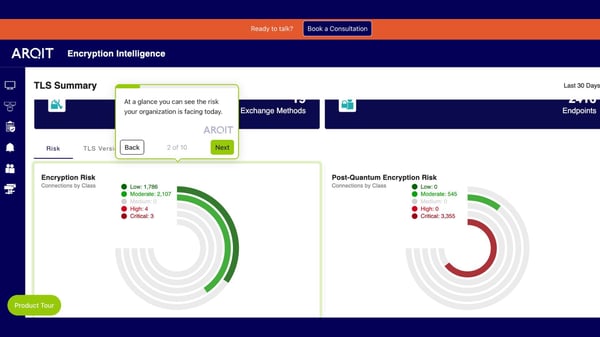
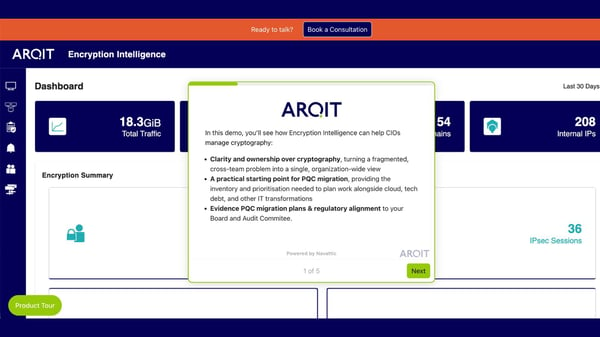
Replace months of manual audit with automated, continuous scanning. Discover every cryptographic algorithm, certificate, key, and protocol in use - including those hidden in legacy systems and third‑party dependencies that manual processes consistently miss.
Choose Your Role
Demo by Role
See Encryption Intelligence through the lens that matters most to you.
CISO
Security Leadership
CIO
Technology Strategy
IT Ops
Infrastructure Teams
Consultants
Executive Reporting
Overview
Executive Reporting
Comparison
Encryption Intelligence vs. Traditional Manual Audits
| Capability | Manual Audit | Encryption Intelligence |
|---|---|---|
| Discovery scope | ⓧ Sampled, limited by resource | ✓ Entire estate — networks, APIs, cloud, third-party |
| Time to inventory | ⓧ Weeks to months | ✓ Hours to days |
| Accuracy | ⓧ Prone to human error and gaps | ✓ Automated, consistent, auditable |
| Continuous monitoring | ⓧ Point-in-time snapshots only | ✓ Real-time lifecycle tracking |
| CBOM generation | ⓧ Manual spreadsheet assembly | ✓ Automated, NIST-aligned output |
| Regulatory alignment | ⓧ Requires interpretation | ✓ Built-in NIS2 & NCSC mapping |
| Cost at scale | ⓧ Linear increase with estate size | ✓ Scales efficiently through automation |
Frequently Asked Questions
Traditional approaches to cryptographic inventory rely on manual audits — a process that is time‑consuming, error‑prone, and typically limited in scope. ACDI replaces this with continuous, automated scanning that delivers a complete and accurate picture of an organisation's cryptographic posture.
In the context of post‑quantum cryptography (PQC) migration, ACDI is recognised as an essential first step. Organisations cannot plan a migration to quantum‑safe algorithms without first understanding what cryptographic assets they have, where they are deployed, and which are vulnerable to quantum attack. ACDI provides this foundational visibility.
The CBOM concept has gained significant importance in the context of NIST's Post‑Quantum Cryptography standardisation effort. As organisations prepare to transition from classical cryptographic algorithms (such as RSA and ECC) to quantum‑resistant alternatives (such as ML‑KEM and ML‑DSA), a CBOM provides the evidence base needed to plan, prioritise, and execute that migration.
For financial services organisations subject to regulations like DORA and NIS2, a CBOM also serves as a compliance artefact — demonstrating to auditors and regulators that the organisation has a clear understanding of its cryptographic dependencies and a documented plan for addressing quantum vulnerabilities.
Specifically, a CRQC would be able to execute Shor's algorithm at sufficient scale to break RSA, ECC (Elliptic Curve Cryptography), and Diffie‑Hellman key exchange — the foundations of modern internet security. This would compromise TLS/SSL connections, digital signatures, PKI trust chains, and encrypted data stores.
The most immediate concern is the 'Harvest Now, Decrypt Later' (HNDL) threat: adversaries — including state‑level actors — are already intercepting and storing encrypted data today, with the intention of decrypting it once quantum computing capability becomes available. For financial services organisations, where data sensitivity can extend 20 years or more, this means that data encrypted today with quantum‑vulnerable algorithms is effectively already at risk.
Leading intelligence agencies and industry analysts place Q‑Day within the next 5 to 15 years, making it imperative for organisations to begin their transition to post‑quantum cryptography now.